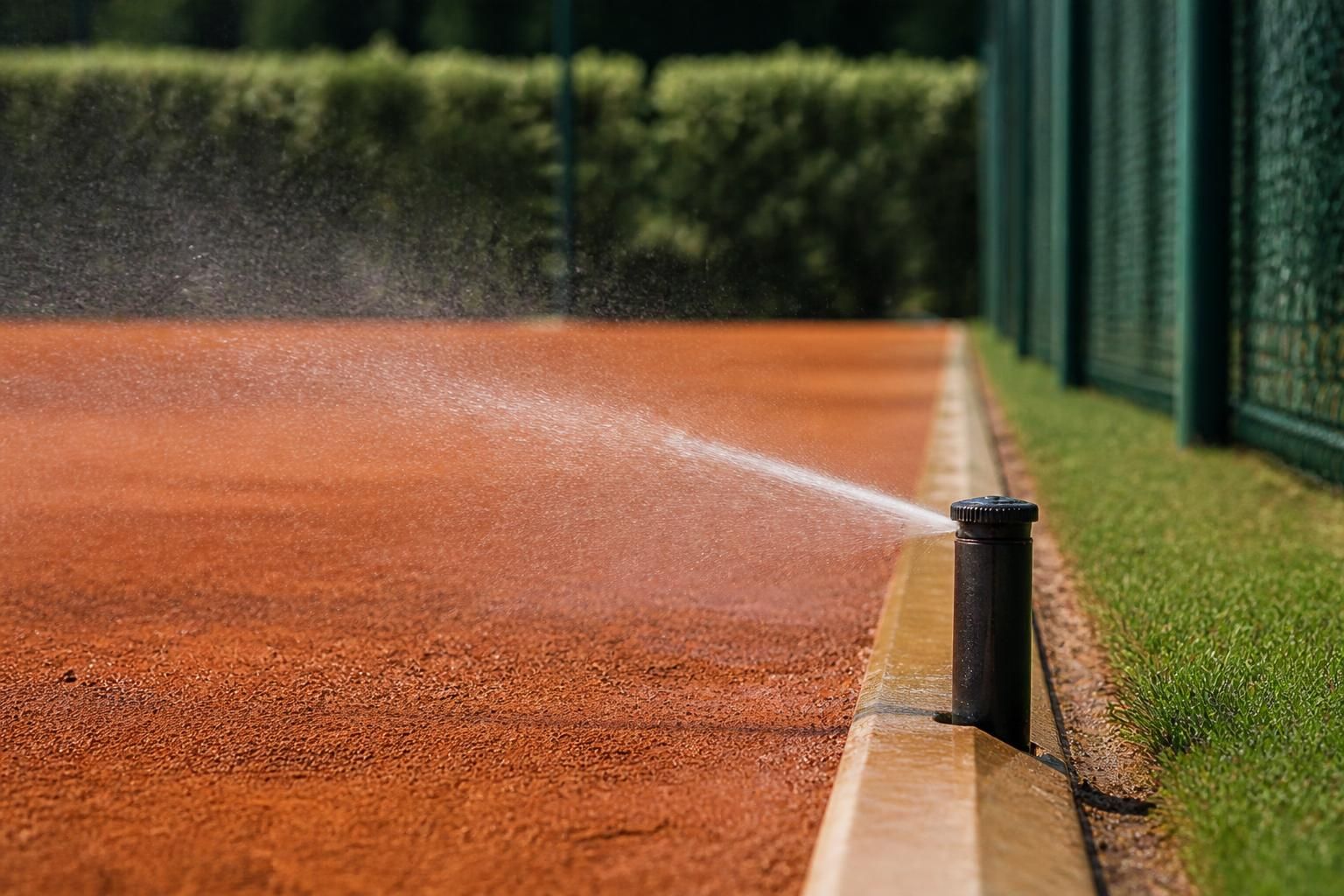
Court Irrigation and Repairs
Fix dry spots, soggy corners, and sprinkler trouble on your clay court with help from a local specialist.
Fix dry spots, soggy corners, and sprinkler trouble on your clay court with help from a local specialist.
Clay Court Solutions handles court irrigation and repairs in Palm Beach, FL for homeowners, clubs, and facility managers who have a clay court that dries out unevenly, floods in spots, or has sprinklers that no longer do their job. To get started, call or send a request describing what you see on the court, and we will go from there.
Maybe one baseline is bone dry by noon while the far corner stays slick. Maybe a sprinkler head is spraying the fence instead of the surface, or the timer waters on days it rained. These problems get worse with South Florida heat, so a short description or a few photos of the trouble spots is a good first step.
Clay surfaces depend on steady, even moisture. When the water supply goes wrong, the court tells you quickly. Watch for these:
Any one of these can be small. Several together usually point to a line, valve, or zone problem that is worth tracing before it damages the surface.
This page covers the water side of your court and the minor surface repairs that come from it. Typical tasks include:
This is the most common call. A single zone that does not run or a head that floods one corner can usually be isolated and fixed without disturbing the rest of the court.
When a leak or a stuck head has saturated the surface, the court may need leveling and refreshed material once the water problem is solved. Fixing the surface before the leak is found tends to waste effort, so the water source comes first.
Palm Beach County has a hot, humid climate with a long wet season that typically runs through the summer and early fall. Afternoon storms can saturate a court one day and leave it baking the next, so an irrigation setup that is tuned for one stretch of the year often needs adjusting for another. Most properties here sit on sandy soil that drains quickly, which means a broken head can leave a dry stripe fast while a leak can wash material away from a low edge. Properties closer to the coast may also deal with salt in the air and wear on metal fittings. We serve Palm Beach, Manalapan, Jupiter Inlet Colony, Wellington, and Boca Raton, and the same patterns show up across them.
Homeowners often lump all clay court care into one job, so here is where this page stops. Irrigation and repairs deal with how water gets to the court and what damage poor watering causes. Grooming is the routine smoothing and brushing of the surface. Surface application adds fresh material and is its own service. Algae removal clears growth that has already taken hold, though fixing a wet spot often keeps it from coming back. Net installation and wind screens are separate jobs as well.
If you are not sure which one you need, describe the symptoms and we will point you to the right starting point. A full court rebuild is a separate service from what this page covers, so ask us if that is what you are weighing.
Most irrigation jobs follow a familiar order. First, the zones are run so the problem can be seen in action. Next, the cause is traced to a head, line, valve, or controller. Then the repair is made and the zone is tested again. Finally, any surface damage near the trouble spot is looked at. Digging is kept to what the repair needs, since torn-up edges and open trenches shorten the life of a clay court.
Whoever you hire, a few standards tell you whether the job was done well:
Court irrigation and repair pricing depends on the situation, so a fair quote starts with a look at the court. The main factors are:
A clear written quote should spell out the scope of work, the number of visits expected, which parts and extras are included, and how changes are handled if a hidden problem turns up midway.
Before hiring anyone for court irrigation in this area, ask:
A quick look at the start of the busy season and after heavy storms is a sensible habit. If you notice dry stripes, soggy corners, or odd timer behavior, have it checked sooner.
Uneven watering usually comes from clogged or misaimed heads, a leaking line, or a zone that is not running. Low spots can also hold water, so the cause may be a mix of irrigation and surface grade.
Yes, minor court restoration is part of our work. We generally fix the water problem first, then address washed-out or uneven areas.
It depends on the number of zones and heads involved, how hard the problem is to trace, the parts needed, the amount of digging, and any extra surface work. A written quote should list each of these.
That depends on the size of the repair and the weather. A head replacement is usually quick, while a buried line fix and surface touch-up takes longer. We can talk through timing once we know the scope.
Send a short description of the symptoms, which areas of the court are affected, and a few photos if you can. Mention your city so we can plan the visit, whether you are in Palm Beach, Wellington, Boca Raton, Manalapan, or Jupiter Inlet Colony.
Tell us about your court and what you are seeing. We will get back to you with a clear next step.